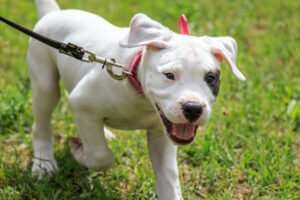
 You thought that you had put in the work. You went to puppy classes, you practiced consistently, you maintained the training. Your dog was sitting on cue, walking reasonably well, coming when called. Then somewhere around six months, or eight, or ten, something shifted. The dog that used to gleefully respond to your commands now tacitly ignores you. The dog that politely walked at your side now drags you down the street. You rack your brain trying to figure out if something is wrong, or if this dog is just built different.
Most adolescent dogs have not forgotten their training. The training is being challenged by stronger environmental, hormonal, and genetic motivations than the dog encountered in puppyhood.
He isn’t broken nor has he forgotten. He has entered adolescence, and adolescence presents competing interests that your training foundation is now up against. Whether that foundation holds depends on how solid it was to begin with, and what you do next.
After over 40 years of training dogs and the people who live with them, I have worked through this stage with hundreds of dogs. What follows is what I know about why it happens, what it actually looks like from the inside, and what to do about it.
It’s Not Regression, It’s Competition
Owners use the word “regression” because it feels accurate. The dog was coming when called, now the dog is not. Something went sideways, but that framing puts the problem in the wrong place.
The training did not disappear. What happened is that competing motivations like sexual maturity, genetic drives, and the accumulated experience of a life lived so far has become more interesting and has gotten loud enough to drown out your cues. The foundation you built in puppyhood is still there. It is simply being outbid by other interests.
Think of it this way: when your dog was eight weeks old, you were the most interesting thing in the world. There was no competition. Now there is. A squirrel, a smell, another dog, an intact female two blocks away, the sheer pull of forward momentum. Any of these other interests can outweigh a simple “sit” command that may not have been adequately tested under distraction.
Obedience is what keeps competing motivations manageable. A dog with a solid foundation bends during adolescence but holds. A dog with a thin foundation will be challenged by distractions, and owners mistake those challenges for defiance. This is the same foundation that determines how a dog handles stress, fear, or aggression later in life. It is not defiance. It is the natural consequence of a foundation that was never tested under the weight of external and changing influences.
This is also why the question of whether your dog is actually listening matters so much before adolescence arrives. The habits built in that window are the ones you are drawing from now. If that is a gap you are already dealing with, this post on why dogs ignore their owners covers the ground directly.
What Is a Behavioral Age Range?
I use the term “behavioral age range” deliberately, because the calendar is not a reliable guide to where your dog actually is developmentally. Chronology tells you how many months have passed. Behavioral benchmarks tell you where the dog is mentally and emotionally.
Adolescence in dogs runs roughly from around 3 months up to 24 months. That is a wide range, and it is intentionally wide. Some dogs hit the most disruptive phase at five months. Others cruise through early adolescence and hit a wall at 14 months. Breed maturation rate matters. Individual development matters. The dog in front of you matters more than the number on the calendar.
What I watch for are behavioral markers: the first sustained interest in environmental distractions over handler focus, the onset of sexual maturity and its associated behaviors, the emergence of genetic drives, guarding or herding instincts that were background noise before and are now blatantly obvious. These are some of the benchmarks. When they show up, your dog has entered a specific behavioral age range, typical of dogs of that breed, type, or period of development, regardless of the dog’s birthday.
The practical implication is that “wait until they’re older” is not a strategy. Adolescence is not a fixed event on the timeline that you can plan around. It is a moving window that requires you to be paying attention. Dogs do not “grow out” of behaviors. They grow into them.
Why Young Brains Learn Faster (And What That Means for You)
There is a reason experienced trainers press hard on early puppyhood, and it is not sentimentality about puppies. Neural plasticity, the elasticity of the young brain, is a genuine advantage that slows over time.
The puppy has no competing experience. Everything you teach it, it absorbs without having to displace anything that was there before. The value of curiosity makes the young dog want to learn. There are no established patterns pushing back against the new information.
The adolescent dog is in a different situation. The value of experience has already begun to shape what the dog finds of value. Learning does not become impossible— I work with adolescent and adult dogs every day— but during maturation, it will be competing with established interests. What took a puppy fifteen minutes to learn can take an adolescent dog significantly longer, not because the dog is less intelligent, but because there is more traffic on the road.
Session length matters more than session count, which is why I teach in short blocks. Eight minute dog training explains why that works.
This is the argument against waiting. Many owners hold off on formal training because they believe the adult dog will be easier, more settled. By the time the dog is a mature adult, its neural pathways are established. The behaviors you wanted to shape have been shaped already, by life, by habit, by whatever the dog found rewarding on its own terms. Working with that dog is not impossible. It simply starts further back than it had to.
If you have a puppy right now, this is the moment. If you are already in adolescence, you work with what you have, and you start today, not after another month of hoping it will resolve on its own.
What You Allow, Will Continue
The adolescent dog that is testing its autonomy is not doing something new. It is doing what has, somewhere along the way, been inadvertently allowed and reinforced. This is one of the harder truths for owners to comprehend, because the reinforcement usually happened without anyone noticing.
The dog that jumps up on people gets touched, moved, redirected, all of which is physical contact, which is what the dog wanted to start with. The dog that pulls, gets to go where it was pulling toward, because releasing leash tension is still forward motion. The dog that whines and fusses gets soothed, because the owner does not want the dog to make noise and conflates noisemaking with being stressed. Each of those responses is a transaction, and the dog is registering every deposit.
The dog is not the problem. The dog is the litmus test. Its behavior is a direct reflection of the signals it has received. Handler clarity and consistency are what shape the dog’s behavior, and handler confusion produces a confused dog, not a defiant one.
This is especially true in multi-person households. Multiple hands on one dog with conflicting intentions will produce a dog that is not trained by anyone. One person lets the dog on the furniture. The other does not. One person requires the dog to sit before being fed. The others may not. The dog is not being stubborn when it ignores the rule; it is responding accurately to the fact that the rule is not consistently applied. Unified handling, consistent expectations, and when in doubt, silence rather than repetition are the corrections that matter here.
You can read more about how in-home training addresses these handler dynamics specifically, because the context where the behavior happens is where it should be addressed.
The Foundation That Holds Through Adolescence
Dogs that were taught early to accept handling, restraint, and confinement move through adolescence with manners. Dogs that were not taught this arrive at adolescence with an agenda.
The investment looks small in puppyhood. Handling the full anatomy, the ears, the mouth, and the feet. Teaching the dog to accept being restrained and manipulated without protest. Building the tolerance for frustration that makes training possible under pressure. It is neither dramatic nor painful. Owners sometimes skip it because it seems unnecessary when the dog is small and cooperative, or because Fluffy WiggleBum had a bit of a meltdown and the owner figured they “would try again later”. When the dog is 60 pounds and throwing hands, the absence of that early work becomes self-evident.
The dogs that navigate adolescence smoothly are the ones whose owners did that foundational work consistently, even when it seemed like overkill. They may have needed reminders, but not remediation. The dogs that show up with no tolerance for restraint or touch, had never been confined, require full remediation, and the owners pay for circumventing the inevitable, in frustration, and in a dog that has practiced its problem behaviors for months.
Working Through It – What This Actually Looks Like
When a dog is in the thick of adolescence, the instinct is to push harder. Repeat the command more firmly. Add pressure. Show the dog who is in charge. That instinct is predictable and almost always counterproductive.
Slow is the best speed. You start below the level of frustration where the dog begins to protest. You build on success. When something is not working, you do not escalate; you go back to where it was working and build again. We do not start with confrontation. We do not end with it either. The goal at every step is cooperation, not compliance through opposition.
Proactive handlers anticipate. They set up the scenario before the dog is already overwhelmed. They work the dog in the environment where the problem occurs, at the level of distraction the dog can actually handle, before increasing the degree of difficulty. Reactive handlers oppose after the fact, which is always harder and always less effective. The transition from reactive to proactive is one of the most significant shifts an owner can make, and it does not require a new set of tools; it requires careful observation and knowing what to do and when to do it.
The full protocol for working through adolescence is what I cover in our training programs. What I can tell you here is that the approach is not punitive, it is not passive, and it works when applied consistently. The leash is a conduit of information that flows both ways. If you know how to use it, the adolescent dog can hear you through it clearly. If you do not, the noise goes in both directions and neither of you gets useful information.
The dogs that come out the other side of adolescence as genuinely reliable, settled companions are not the ones whose owners waited it out. They are the ones whose owners understood what was happening and worked with it, methodically, without drama.
Ready to Work Through This?
If your dog is starting to throw you the doggy equivalent of the middle finger, the answer is not to wait. The behaviors being practiced right now are the ones that will be established by adulthood.
If you are in Carroll County, book a consultation here and we can work with you in your home, where the problems are actually being practiced.
If you are outside our service area, virtual training is available and covers the same ground. The delivery of the information does not change the outcome, and the instruction is what matters.
Your dog is not broken. The opportunity for learning is not closed, but it is moving, and sooner is always better than later.
Linda Kaim is a NADOI certified dog trainer with over 40 years of experience, based in Carroll County, Maryland. She offers private in-home dog training throughout Carroll County and virtual training for clients outside our coverage area.