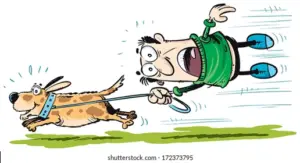
 You call your dog. Your dog hears you. You know it heard you because one ear twitched in your direction before he went right back to investigating whatever is infinitely more interesting than you are. You call again. Nothing. You walk over, try to snap on the leash, and your dog bolts away from you as if this is perfectly normal, because as far as your dog is concerned, it is.
A dog that ignores its owner has learned that responding is optional and that the environment is more reinforcing than the handler.
This is one version of the problem I see over and over, in living rooms and backyards across Carroll County and on video calls with clients around the country. Your dog is not deaf, nor is your dog stupid. Your dog has simply learned that paying attention to you is optional, and nobody ever made it otherwise.
After more than 40 years of working with dogs and the people who love them, I can tell you that the “my dog ignores me when I call” problem is one of the most common complaints I hear, and one of the most misdiagnosed. Let’s sort out what’s actually going on.
It’s Not Stubbornness, It’s a Reinforcement History
Dogs do not ignore their owners out of spite, defiance, or some personality flaw. Ignoring you has simply been reinforced, usually without you ever meaning to do it.
Every time your dog heard a command to “come” and kept on running (and nothing happened), he learned that “come” is a word with no consequences. Every time he found something more interesting than you and was allowed to investigate, he learned that the environment is a reliable source of reinforcement and that you are not. Every time he pulled toward a smell, another dog, a person, and got to make contact, ignoring you was rewarded.
This isn’t your dog being difficult. This is your dog being a dog, and doing exactly what repetition taught it to do. The reinforcement history got built one unanswered call at a time, one “oh, we’ll try again later” at a time. It accumulates quietly, and then one day you’re standing in the street calling a dog that has no particular reason to come back to you.
The good news is that reinforcement histories can be rewritten. The process is not always fast, and it requires structure and discipline, but it is not mysterious. The first step is understanding what you’re actually dealing with.
Exercise Won’t Fix It (And Usually Makes It Worse)
The advice I hear constantly is some version of “just tire the dog out,” or some version of “A tired dog is a happy dog!” “Sniffaries” and trying to fulfill your dog’s genetic potential is the fast track to getting pulled into oncoming traffic when your dog thinks his entitlement means you are just an afterthought.
Tired is not happy. Tired is tired.
Physical exercise, on its own, does not solve an attention problem. What it can do is create a fitter athlete. You run your dog two miles a day this week, and it needs three miles a day next week to reach the same level of fatigue. Meanwhile, the underlying attention deficit is completely ignored. The dog still finds the world more reinforcing than you. It’s just in better shape to oppose you now.
Exercise is not the enemy. But exercise as a substitute for training is a losing strategy, and it’s one that leaves a lot of owners exhausted and frustrated by their dogs.
That exhaustion has a pattern to it, and I unpack it in my dog is driving me crazy.
What Does It Mean When Your Dog Ignores You?
At its core, a dog that ignores you is a dog that has assigned more value to the environment than to you. The squirrel is worth more than you are. The pee-mail on the fence post is worth more than you are. The other dog across the street is worth more than you are.
This is not a breed problem. It is a training gap, and the distinction matters because breed-blaming leads nowhere. It may offer an excuse that forecloses solutions. “Oh, that’s just how [insert breed] are.” That is not useful, and in my experience it is not accurate. Breeds may have genetic influences to act a certain way, but all dogs have the ability to learn how to control their impulses. We just need to be prepared and influence both the option and the outcome. Breed-blaming is one excuse among many, and I have heard most of them. Why people don’t train their dogs covers the rest.
What IS accurate is this: the dog has found reliable sources of reinforcement that do not originate through you. The world has plenty of value in it. You are just not central to that value. Once you understand that, the path forward becomes evident, because now you know what you’re actually working on. You are working on establishing your own relevance.
A dog will not offer attention to you while its focus is fully committed elsewhere. They care only about what they are looking at, and if what they are looking at is not you, then they’re not thinking about you, regardless of what you are saying or doing. Competing with distractions before a solid attention foundation exists is a losing strategy, and it’s one I see owners try and fail with constantly. The answer is not harsher tools, better treats or a louder voice. The answer is a different strategy.
Tools come up every time this conversation happens, so I went through the actual research on them in what the science actually says about shock collars.
The Foundation Problem Nobody Talks About
Training your dog to pay attention is not a parlor trick. It is the foundation for strong obedience, and one cannot be cleaved from the other. The same foundation is what makes behavior modification possible in dogs displaying aggression or defensive behavior.
When I am training a dog to “pay attention”, we are working on that skill from the very beginning in a very specific way. The dog is never reinforced for ignoring me, because there is never an opportunity to. This is not a random generalization. During the introduction to the exercise, the dog is never given an opportunity to escape or avoid consequence for refusal or failure. I can compel what I do not receive voluntarily, and I only reinforce cooperation. This forms the structure through which real attention becomes possible. A dog that doesn’t walk quietly beside you has not learned how to pay attention to you. A dog that doesn’t have a reliable recall has never been required to prioritize you over the environment. A dog that doesn’t understand how to remain motionless has never been asked to manage its own internal state.
The stand-stay exercise is particularly underestimated. When a dog holds a stand-stay in the presence of something it wants, it is doing something genuinely difficult: it is internalizing its own emotional state and choosing self-regulation over impulse. That is the same mechanism at work in every exercise. The dog that can hold a stay while distracted is learning something much more important than “hold still.” It is learning that its impulses are not in charge.
This is why a dog can “know” its name and still ignore it. Recognizing a word and having the behavioral foundation to respond to it under any conditions are two completely different things. If the foundation is not there, the attention is not reliable, and reliable is the only kind of attention that matters.
You can read more about the foundational skills we use in private in-home training and how they connect to every other behavior goal you have for your dog.
What Should I Do If My Dog Ignores Me?
The short answer is: stop competing with the environment and start controlling access to it.
The handler has to become the source, not just a participant. This means that access to the things the dog finds rewarding is only available through you. The dog does not get to self-reinforce by investigating the smell, the dog, the person, the squirrel on its own initiative. The dog may never get to access those things, unless you permit it. Reinforcement can come in other ways, but only through you and only through cooperation.
This is not about being punishing or withholding rewards. It is about creating value in your presence and reinforcing cooperation. The leash and collar are not optional tools in this process. They are what make the magic happen. Without physical management, you are negotiating with a dog that has no reason to negotiate. The leash is a conduit of information that flows both ways. When used correctly, it does not restrict the dog’s world; it teaches the dog to navigate that world in a way that keeps you in it.
The foundational attention exercise I introduce to dogs starts on leash, in low-distraction environments, and works from a very specific premise: the dog learns that looking at the handler is the gateway to everything. Not because a treat is being waved in front of its nose, but because the handler controls access to what the dog wants. The dog figures this out, and when it does, the change in its orientation is visible. The head turns. Eye contact is made. The dog starts checking in, not because it’s told to, but because it has learned that you are the harbinger through which all good things flow.
I cannot walk you through the full protocol in a blog post, because done incorrectly, it produces the opposite of what you want, and forty years of teaching this have shown me that the initial work matters a lot. What I can tell you is that the approach works, it works reliably, and it is teachable to virtually any owner willing to follow instructions.
If you are in Carroll County, Maryland, this is work we can do together in your home, in your yard, with your dog’s actual distractions. If you’re outside the area, the same foundation applies and translates well to virtual training sessions.
A Note on Food and Recall
There is no crime in introducing high-value treats to build a solid recall. This approach is everywhere, and for some dogs in controlled settings, it produces some results. Your freeze-dried liver is not competitive enough for the dog who is at war with the squirrels, rabbits and neighbor’s lawnmower.
The problem is that food, used this way, can function as a predictor of arousal rather than a reinforcer of calm attention. You produce the treat, the dog’s arousal goes up, and now you are competing with that arousal rather than working through it. The dog learns to respond to the treat cue, not to you. Take away the treat and the recall always goes with it. Make the treat compete with a dog in a high state of arousal, and the treat always fails.
My approach is very different: the goal is for you to become the resource, not for you to be the carrier of the resource. The food, the toy, the access to anything the dog wants, you are now the sole source. The dog is not responding to what’s in your hand. It is responding to you, because you are the one who determines what happens next.
That is a different thing, and it produces a different result.
Ready to Work on This?
If your dog tunes you out, blows past your recall command, or treats the leash like a suggestion, these are all solvable problems. They require a plan that consistently produces results.
If you are in Carroll County, Maryland, I offer private in-home dog training built around your dog’s environment and your specific situation. You can book a consultation directly at calendly.com/lionheartk9/30min.
If you’re anywhere else in the world, virtual dog training covers the same foundational work and has produced real results for clients across the country and internationally.
The dog that ignores you now is not the dog you’re stuck with. It is the dog that is waiting for the right signal. That is a solvable problem.
Linda Kaim is a NADOI certified dog trainer with over 40 years of experience, based in Carroll County, Maryland. She offers private in-home dog training throughout Carroll County and virtual training for clients worldwide.