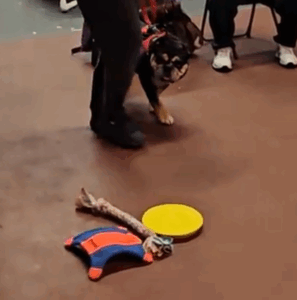
 Resource guarding is the defensive control of food, objects, locations, people, or other resources the dog considers valuable. One of the most mishandled behavior problems in the domestic dog, it is also one of the most preventable. Those two facts existing simultaneously should tell you something about how this typically goes.
Let me be direct about something before we go any further. Resource guarding is 100% natural. It is a survival tactic that has been encoded in dogs since before domestication, since before selective breeding, since before the first wolf decided that the warmth of a human fire was worth tolerating the smell of people. The first anti-social behavior observable in a litter of puppies before their ears and eyes are even open is resource guarding. They scrabble in the darkness for the warmest spot and the best spot at the milk bar. The dog that gets there first, defends it. That is not aggression. That is evolution doing its job.
What people don’t want to hear is that they are almost always responsible for making it worse.
What Dogs Are Actually Defending
A resource, in a dog’s world, is anything with perceived value. Food is the obvious one. But the list extends considerably further than most owners realize.
A toy, a sleeping spot, a particular cushion on the couch, access to a doorway, proximity to a specific person. Even a sock pulled from the laundry basket. Toys, chews, a piece of trash retrieved from the recycling. The dog does not distinguish between items you consider valuable and items you consider worthless. The dog’s assessment of value is entirely its own, and entirely non-negotiable from the dog’s point of view.
Guarding behavior runs a spectrum. At the low end, it looks like a hard stare, a slight stiffening of posture, or a dog that subtly repositions its body to place itself between you and whatever it has. These signals are quiet and easy to miss. At the high end, it is a growl, a snap, or a bite. The dog that bites over resources did not arrive there suddenly. It arrived through a long series of escalating signals that the humans around it either did not notice or responded to incorrectly, including chasing the dog down to punish it or wrestling the object away from it.
Where Humans Make It Worse
The most common human response to a dog that has grabbed something it shouldn’t have is to pursue it, yell at it, or worse, try to grab for it. Chasing your dog around the furniture may feel like the right response. I assure you, it is not.
What the dog experiences in that moment is a larger predator trying to compete over a contested resource. Its evolutionary instructions are clear: run, and when you cannot run anymore, fight. The human thinks it is playing keep-away. The dog is actually practicing a skill that a million years of genetic coding told it that this is a strategy it may one day need to survive.
Every time the human chases, the dog learns that grabbing something valuable produces a chase. Chasing is arousing. Arousal increases defensive drive. The dog that starts by trotting off with a sock becomes the dog that eventually turns and holds its ground. That progression does not happen overnight, but it happens reliably.
The other thing humans do that increases resource guarding is reaching into the food bowl while the dog eats, in some warped form of ‘dominance’. I watched a video recently of someone sticking his hand in his large dog’s bowl mid-meal, driving the dog back, explaining why this is the correct approach. The dog’s expression told a different story. The average person who watches that and tries it on their own dog has a reasonable chance of ending up in the emergency room.
Keep your hands out of your dog’s food bowl. Imagine someone grabbing food off of your plate as you eat. I would imagine that would not go unanswered. Just like the animals, we are resource guarders, too.
The Mouthing Connection
One of the things I counsel owners on constantly is how they handle inappropriate mouthing, because it is directly connected to how resource guarding develops.
Dogs are curious creatures. Most of their information about the world comes through scent, but they do sample things with their mouths. Much of the time, that mouthing is information-gathering, not aggression. Puppies mouth because they are puppies. They are practicing autonomy, exploring instinctive behaviors, testing cause and effect. They are not trying to overthrow the government.
What owners do when a puppy grabs something is the problem. They snap the leash out of its mouth. They yell. They reach down and rip the item away with their hands. They lunge for whatever the puppy has absconded with and chase it around the room.
Every one of those responses teaches the dog to grip harder and guard more intensely. It conditions the dog to become defensive against opposition — to treat your hand near an object as a threat worth meeting. This is one of the primary reasons people get bitten by their own dogs over food, toys, and ordinary household items that were never supposed to be a contest in the first place.
If a puppy on a leash grabs the leash itself and mouths it, I am not arguing with an animal that weighs less than my pair of winter boots. I make it uncomfortable enough when she grabs the leash that holding on stops being interesting, and I wait until she releases it through attrition. When she does, I direct her toward something she is allowed to have. I do not offer a substitute immediately, before she releases. If she grabs something and I swoop in with a treat or a preferred toy while she still has it, I have just taught her that grabbing things produces rewards. That is not a lesson I want installed in her permanent memory.
The distinction between redirecting after release and trading before release is small in execution and enormous in consequence. Be careful what you are reinforcing.
Prevention: The Leverage You Only Have Once
The easiest time to influence resource guarding behavior is before it becomes a pattern. That window is puppyhood, and it closes faster than most owners recognize.
Management is the foundation. If a puppy is on a leash and collar, she cannot access things or places I have not sanctioned. She cannot grab the tea towel, make off with a shoe, or claim the couch cushion as her sovereign territory. Leash and collar management, combined with crate confinement when direct supervision is not possible, removes the opportunity for these patterns to establish themselves in the first place.
Toy selection matters more than most people think. Interactive toys — tugs, retrieve items — are for organized play with a handler. They are not left on the floor. When the session ends, they go away. Pacifier toys, items the dog can engage with independently during crate time, are made of durable, non-destructible materials and are sized appropriately so they cannot be swallowed. The distinction between the two is not arbitrary. It is a management structure that controls what the dog has access to, while it learns cooperation over perceived resources and that competition over them is unnecessary.
Food feeding should be structured. Bowls go down, bowls come up when the meal is done. Nothing lingers. Pacifier chews like bones and antlers are given in the crate or in a space where no other dog or person is competing for proximity. This removes the scenario before the dog has any reason to practice defending it.
The goal is simple: if the dog never rehearses the behavior, the behavior does not become a habit.
Working With an Adult Dog That Already Guards
The adult dog with an established history of resource guarding is a harder problem, but not an impossible one. The critical factor that most owners cannot manage reliably is emotional neutrality.
Humans are not neutral. When a dog growls at them over a food bowl or charges another dog over a toy, the human responds with frustration, alarm, or escalating pressure. All of those responses are gasoline. The dog reads the emotional change in the handler as confirmation that the resource is worth defending, otherwise why would the human be so affected by it?
The reprogramming process requires that the handler approach contested resources without body language, tone, or timing that signals agitation. That is an unnatural ask for most people. Which is why this is the piece I tell owners they cannot reliably do alone.
The process involves building a foundation of cooperation that makes the dog’s defensive response to the handler unnecessary. Not through tossing cookies at a growling dog, which reinforces the growl. Not through dominating the dog into submission over its food bowl, which reinforces the dog’s concern over the presence of the human near the resource. Through carefully constructed scenarios where the dog repeatedly discovers that the handler’s proximity to a resource is not a predictor to an unpleasant event, and that cooperation is safer and more rewarding than defense.
That process has a lot of moving parts. It requires reading the dog’s communication accurately and responding before the dog reaches a level where defense feels mandatory. If you are consistently getting rigid body posture and defensive behaviors, you are already past the point where you should be handling this without guidance.
What Resource Guarding Between Dogs Looks Like
When the household has more than one dog, resource guarding dynamics become significantly more complex. Two dogs cohabitating does not mean two dogs sharing. It means two dogs with their own assessments of what is valuable and their own opinions about access to it.
Dogs in a multi-dog household should be fed separately, with no opportunity for one dog to approach the other’s feeding station during or after the meal. Toys that have historically produced tension between dogs are put away entirely until the training foundation exists to manage them reliably. Remember, dogs do not “share” resources, so in order to minimize conflict, most resources should be removed entirely, or made temporarily unavailable until self-control in their presence has been established.
The dog that guards the human from other dogs in the same household (positioning itself between the person and the other dog, escalating when the other dog approaches), is guarding the most valuable resource in the environment. That behavior is not affection. It is possession. And it compounds quickly in a household where the human misreads it as loyalty.
If you are trying to work out who is qualified to give that input, start with knowing the difference between a trainer and a behaviorist.
When To Call Someone
Habitual resource guarding should include professional input, period. Not because the behavior is exotic or untreatable, but because the execution of the protocol is precise enough that well-intentioned errors by the handler can entrench the problem or produce an injury.
If you are in Carroll County, private in-home training is the appropriate starting point. A virtual consult helps determine what you are working with and which training approach is appropriate.
If you are anywhere else, virtual training is available and suited to this kind of work. Equipment, management structure, training mechanics, and the reading of dog communication can all be addressed in real time via the internet. The dog’s behavior does not change because the trainer is remote. The handler’s behavior is where change is made, and the handler is right there.
Resource guarding is one of the most preventable behavior problems in dogs. It is also one of the most serious when it is left to develop unchecked. The distance between a puppy that mouths the leash and a dog that bites over perceived resources is a litany of inappropriate human responses, each one slightly more reinforcing of a behavior the dog was always capable of. That distance is also where the solution lives.
Start before you have a problem. If you already have one, start now.