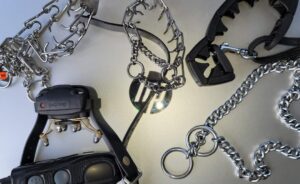
 There is not a day that goes by where someone is not making a comment somewhere on the internet about dog training collars. What should be used. What should not. Why one is better than the other, what makes one cruel, what makes another gentle. You would think that one’s proximity to heaven is contingent on one’s beliefs about dog training equipment.
I find it strange that the people most loudly condemning a particular collar’s use do so not out of any real experience, but by clinging to the repeated mantras of a loud and profoundly ignorant contingent that has rehearsed the talking points so many times they have lost the courage to discover the truth for themselves.
A dog collar is a tool. The same as a leash, a crate, a dog bowl, or any other device we use to live with, manage, and communicate with dogs. The collar is not the problem. The perception that certain collars are inherently cruel, is.
I have used every device out there. There are some I prefer, and even among those, some I use only occasionally. I am glad to have all of them available. My selection process starts with the most basic collar and judges from there. Decisions are always based on the animal in front of me, the goal, and the conditions under which the dog will be expected to perform when handled by someone who is not me.
That last part matters more than most people consider. I work with people of all ages and abilities. What becomes apparent quickly is that helping an owner effectively control their dog with the tools readily available to them is not a luxury. It is the job. A tiny woman who owns a 90-pound adolescent dog has different needs than a fit handler working a gun dog in the field. The tool that bridges the gap between what an owner can physically accomplish and what the dog may specifically require is not cruelty. It is competence.
Pressure Is the Engine of Everything
Before we talk about specific collars, we need to talk about pressure. Because every collar, without exception, works by applying and releasing pressure. That is not a controversial statement. It is the mechanical reality of every training device ever made, from the strip of sinew around a proto-dog’s neck in a cave camp to the 127-level remote collar hanging on my wall of gear right now.
Pressure is also the engine of evolution. Social pressure, environmental pressure, physical pressure, performance pressure. Every living thing navigates it. The newborn pup competes for the warmest spot in the whelping box and access to the most generous teat. Competition is fierce with littermates, even before ears and eyes open. Failure is not ‘punishment’. It is information, delivered in the only language dogs have understood for tens of thousands of years.
Understanding this one thing changes everything about how you evaluate training tools.
The application of pressure is not punishment. Punishment is one specific use of pressure, applied to suppress a behavior. But pressure can also be applied as a guiding force, a signal, a conduit of information. What the dog does with that pressure, and what the handler does with the release, is how learning happens.
The collar does not train the dog. The handler does. The collar delivers information. How that information is used is entirely a function of the person holding the leash.
If you are working with a dog and struggling to choose the best training equipment, this is exactly the kind of thing that is addressed directly in private in-home training sessions in Carroll County, and through our virtual training clients outside our coverage area. Understanding what the leash and collar communicate is foundational. Your progress begins with the right choice in equipment.
The Collars Themselves
Flat Buckle Collar
The starting point. Appropriate for ID tags, everyday wear, and as the baseline from which every training assessment begins. Not a training collar in an active sense. If a dog can be trained reliably on a flat buckle collar, then it satisfies the definition of a training collar. Usually as the dog matures, the flat buckle collar becomes less meaningful as a control device, is often not fit correctly, and generally increases resistance as the dog learns that the pressure never increases or decreases as it pulls on the leash.
Martingale Collar
A variation on the slip design, with a fabric or chain loop that limits how far the collar can tighten. It cannot close beyond a set point, which makes it appropriate for dogs with narrow heads relative to their neck circumference, and for dogs that are more temperamentally sensitive. It still tightens and releases as a communication signal. It simply cannot overtighten.
Slip or Training Collar
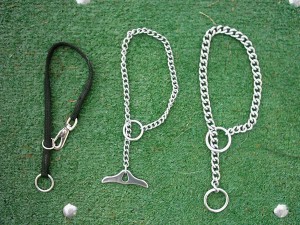 Some form of slip collar has existed for hundreds of years. It is still the most purchased dog training collar on the planet, and for good reason. It is the standard by which every other mechanical collar is measured, and still the only collar permitted alongside the flat buckle in AKC obedience titling events.
The slip collar’s design is simple: a ring at each end of a chain or fabric loop. Applied correctly, it tightens and releases instantly. Applied incorrectly, it hangs up and never releases. That distinction — correct application versus misapplication — is the source of this collar’s unfortunate nickname and virtually all of the controversy around its use.
There is one correct way to place a slip collar on a dog. If you do not know what that is, find out before you use one. Placed correctly, it is one of the most effective and humane training tools available. Placed incorrectly, it earns every bad review it has ever received.
Slip collars are never appropriate as tethers. They are training tools. On during training, off when you are done. No exceptions.
Head Halters
I will address these briefly, because they occupy a considerable amount of real estate in the “humane training” conversation and they deserve a clear-eyed assessment.
Head halters function on the same principle as horse halters: control the head, control the body. In certain limited applications, that is true and useful. I have used them in specific circumstances. For a dog who needs to be still for a medical procedure, or occasionally in conjunction with other equipment during the initial stages of working with a physically imposing dog for a very small owner, they have a role.
As primary training tools, they are management devices, not training devices. The dog wearing a head halter is not learning to walk with you. It is being physically prevented from going elsewhere. Remove the halter, and you have the same dog you started with, because nothing has actually been taught.
My specific objection to head halters is what they do to communication. A dog’s primary means of expressing itself is its facial expression and head carriage. Restraining the head does not produce a calmer dog. It produces a dog that is suppressing communication because it cannot express it any other way. That subdued, inhibited appearance that head halter advocates often interpret as “calm” is, in my experience, more often a dog that has given up trying to communicate. That is a very different thing.
Dogs trained to the highest levels of performance in any discipline are not trained on head halters. There is a reason.
No-Pull Harnesses
The correct use of a harness is to distribute weight across a larger surface area for draft and working dogs. A sled dog working into a properly fitted harness is experiencing comfortable, distributed pressure in service of a task it was bred to perform.
The no-pull harness as currently marketed for pet dogs has repurposed the original design to do something functionally opposite: maximize pressure at contact points to deter forward motion. That means a dog throwing its weight against a front-clip harness is applying an inordinate amount of pressure to parts of its body the harness is in direct contact with; under the armpits, across the chest, potentially still making contact with the larynx. The torque from the momentum that compels the dog to turn has led to cervical injuries that the manufacturers fail to warn adequately about.
I do not endorse no-pull harnesses as training tools. If you want a dog that does not pull, train the dog not to pull.
Prong or ‘Pinch’ Collar
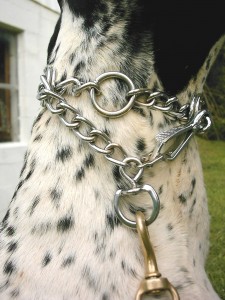 The prong collar has existed in some form for well over a hundred years. Herm Sprenger is its earliest commercial producer, with patents dating to 1876. Konrad Most references spike collars in his 1911 manual “Training Dogs.” The design is not new. The controversy around it is considerably newer than the collar itself.
Here is how it works: the collar is a series of interlocking links, each with blunt, rounded prongs facing inward. When the collar tightens, the prongs apply equal, simultaneous pressure around the circumference of the neck. Not a single pinching point, not a spike. Evenly distributed pressure, which is by design the opposite of concentrated pressure.
The prong collar’s frequent description as “power steering for dogs” is accurate. For a handler being physically outmatched by their dog, it changes the equation quickly. The dog learns rapidly that moving into the pressure is less comfortable than moving away from it. Self-correction is the mechanism. The handler does not have to fight. The handler simply needs to control the leash effectively.
Prong collars must be fitted correctly. Too loose, and they do not function as designed. Too tight, and pressure can never be adequately relieved. Positioned correctly, they sit high on the neck. Removal when the dog is unattended or crated is necessary and non-negotiable.
The Kimberland Prong Collar is one I recommend regularly for its design profiles, range of sizes, and construction quality. Herm Sprenger remains the gold standard. These are not cheap products, and there is a reason for that.
The goal with any prong collar is to fade its use. Management tools are management tools. Training produces a dog that no longer requires the tool to perform reliably.
Fit matters more than any other variable with a prong collar. The video below demonstrates correct application:
For visual reference on correct fit across all collar types — prong placement, slip collar orientation, and more — see An Evolution of Dog Training Collars. The images in that post demonstrate appropriate application in a way that written description cannot fully replace.
Electronic Collar
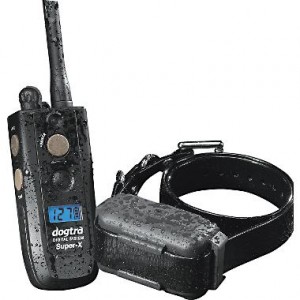 The first electronic training collars were developed by hound trainers who needed to reinforce behaviors at distances a leash could not cover. The TriTronics A1 was the first commercially distributed unit, sold in the 1970s. Built by working dog people, for working dog people, they functioned primarily as aversives in their early form.
That is not what modern electronic collars are, or how they are used by anyone who knows what they are doing.
I had a client some years back, a woman with a small Schnauzer who had become intolerant of visitors, other dogs, and strangers passing the house. She called me because he had escalated to barking, snarling, and rushing at guests menacingly. At some point in our exchange, she asked if I could bring “one of those shock collars” with me.
The term made me wince. Not because it offended me, but because I knew exactly what image it conjured for her, and that image had nothing to do with what I was going to do with it.
I brought my DogTra 1900 Field Star Pro, which on a ten-pound Schnauzer looked comical, but it served the demonstration.
Before I put the collar on the dog, I put the receiver on the belly of her thumb muscle, at the bottom of her palm, where the muscle is large and dense. I held the transmitter and told her to tell me when she felt anything.
She felt it at around a 12. Her husband, a large man, felt it at a 16. I cannot feel it until about a 20. The gymnast I evaluated earlier that summer didn’t perceive any sensation until she reached a 35.
I fit the dog and determine that he will work at level 8 out of 127. Well below the average human detection threshold.
At that level, the collar is not delivering pain. It is delivering information. It is a tap on the shoulder. A stimulus that says: attention to your handler means the pressure stops and the reward appears. In that application, the collar functions as a conditioned reinforcer. The distinction from punishment is not semantic. It is the entire point.
The Schnauzer’s owner grasped something many people openly struggle with. She recognized that what the collar offered her was the ability to apply pressure remotely, without being the visible source of it. The opposition reflex that arises between a handler and a reactive dog during a correction, that the potential for escalating tension between the two of them, is removed. The collar separates her from the process without removing her from its execution. She is still the handler. The timing is still hers. The dog is simply no longer rehearsing opposition to her specifically.
She understood pressure. Most people do, once they get past their fallacious dogma about ‘shock’ and ‘pain’.
If you want the research rather than the rhetoric, I went through it study by study in what the science actually says about shock collars.
The only brands I use are Dogtra and ECollar Technologies. Both of whom have me listed as a resource on their websites. It is a professional alignment based on product quality and the ethics of the people who make them.
Electronic collars are not miracle devices. They are not instruments of cruelty. They are precision instruments that require understanding to be used correctly. That understanding is not difficult to acquire. It simply requires the willingness to learn rather than conjecture or hearsay.
For a closer look at how an electronic collar is introduced and applied in an actual working session, the same reference applies: An Evolution of Dog Training Collars covers the full spectrum of collar types with images that show correct fit and placement across the board.
How Selection Actually Works
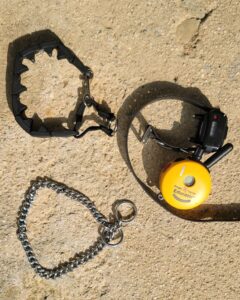 My selection process does not start with the most sophisticated tool. It starts with the most basic one and works from there, based on the animal in front of me and the human who must handle it.
The dog tells me what is needed. The handler tells me what is possible. Where those two things intersect is where the right training tool lives. It is not ideological, it is practical.
Cruelty is a human behavior, not a function of any tool. The person who harms a dog does not need a collar to do it. The device will never really be the issue. Ignorance is. Ignorance about how tools work, ignorance about how dogs learn, and the particular brand of ignorance that dresses itself up as professionalism while leaving owners without solutions and dogs without training.
Collar selection does not happen in isolation. It is part of a broader conversation about how your dog learns, what you are trying to accomplish, and what you are realistically able to execute. That conversation happens in person for clients in Carroll County. It happens through a screen for everyone else — and it translates surprisingly well. Equipment selection, fit assessment, and the foundational mechanics of how to communicate through a leash and collar are all things that can be addressed thoroughly in a virtual session.
If you are in Carroll County and want to know which tool is right for your dog and your situation, reach out for a consultation. Tools are a conversation, not a prescription.
If you are anywhere else in the world, virtual training is available and is well suited to this kind of work. Equipment, application, and the training that makes any tool eventually unnecessary, is now accessible to everyone curious enough to want additional information.