
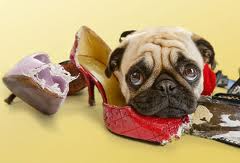
 How To Stop Puppy Chewing
A few days ago I saw a social media post from an individual who was having difficulty with a puppy chewing on non-toy items, not dropping articles willingly and the difficulty he was experiencing with teaching the dog what is ‘forbidden’ and what is ‘acceptable’ as chewing toys.
There was some pretty valuable advice that was offered in response and in a sidebar conversation with one of the group members, I was asked to share an article I had written quite a while ago which outlined an experience I had with a couple of dogs who had come for training; both with an extraordinary commitment to the consumption of ‘stuff’. Both dogs had ended up in need of emergency surgery on multiple occasions and a third dog from the same household had ultimately died from injuries sustained from eating non-food items.
Couched in humor, this article reflects my principal overview of how to help folks through the puppy chewing stage of training and how to better control inappropriate chewing.
- Put your stuff away, as in where the dog can’t get it. That includes making your kids be responsible for their own stuff and put it away too.
*The key point of this is (or should be) obvious. With dogs, the less opportunity they have to practice inappropriate behavior, the less likely they will be to participate in it when and if an opportunity presents itself. Some responsibility must rest with the owner to keep their dog safe and keep temptation away. Dogs are not born knowing what is ‘right’ and what is ‘forbidden’.
- Supervise the dog appropriately (on a leash, with you, IN THE SAME ROOM AS YOU) so you can prevent it from getting your stuff, or your kids’ stuff.
*See footnote one. The other side of the same coin is still prevention. Now clearly, everyone knows it’s impossible for a dog to learn anything about human cohabitation while locked up in a crate, outside, or on a chain. Owners must ultimately take the time and make the sacrifice to teach their dogs what is appropriate and what is not appropriate behavior.
Directing your dog or pup through the minefield of a human world is not as time-consuming or arduous as one might think but it does require three elements; the dogs’ presence, the owners’ presence and the owners’ undivided attention. It is neither difficult nor that time consuming to redirect the attentions of a pup from an interesting article to another interesting article, if you approach the problem smartly and without anger.
Remember, in the case of a young puppy, their access to your stuff is ultimately your problem. If you don’t teach the puppy, or guide it and appropriately restrict its access, you don’t have the right to blame the puppy for something you could have prevented. Don’t assume that by showing a young dog, or even an older dog once or twice that your Gucci handbag is off limits, or that the dog should “just know” either. It is only through the diligent application of a clearly defined training process that you can assure your dog has learned what is appropriate and what is not.
- If you cannot supervise your puppy or dog, crate training so it cannot get anything but stuff you provide.
*The golden rule. If the dogs ability to engage in inappropriate behavior is removed, its inability to practice that behavior will assist in the extinction of the behavior over time. By itself, it’s a pretty simple concept. It’s over-use is the problem. A dog can’t learn in a vacuum. Balance crate time with adequate exercise, attention and training time so that the puppy can learn. Provide an appropriate pacifier toy to satisfy puppy chewing needs and provide something to do in your absence.
- If your dog manages to abscond with something of yours, DON’T CHASE OR ‘TUG’ TO GET IT BACK! You run the risk of encouraging resource guarding with the associated growling and biting and even faster consumption of stuff you would rather not have to fish through poo to get back, or pay exorbitant fees for surgery you probably could have prevented if you paid attention to the first point and/or the second point.
*Far too many times, humans are the unintended sources of their dogs’ resource guarding/frantic consumption/escape-avoidance/aggression and increased incidences of separation anxiety and destructive behaviors due to this one simple act. Dogs are the descendants of Apex Predators. Say what you want about their distinct differences in physiology, but they are still essentially bound by enough similarities in high level behaviors to their wild ancestors, the wolves.
The human influence through selective breeding over the predatory behavior sequences involved in hunting (seek-stalk-chase-bite-kill-consume) may have altered their order of appearance or diminished the intensity in which each sequence is engaged in, but for the most part, the signature hunting instincts are intact; the ability to use sight, olfaction, hearing and speed to locate and bring down game. They remain in all dogs of all breeds by matter of degree.
By creating a conflict of ownership over an object with a dog, we set in motion quite a few unintended consequences involving the key elements of predatory behavior. We don’t change the rules, we change the game. It is far better to acquire cooperation through restricting access, creating positive environments by not forcing the dog to give up the article and by coercing your dog to surrender it politely by offering a trade, a game or an adequate distraction. We do this by encouraging him to drop it willingly and come to you or best-case scenario; bringing the article to you and offering it gladly. Should he do either, praise him warmly and sincerely, exchange articles or engage in a quick game to reward him for his cooperation.
- Provide appropriate toys! My rule is: inorganic toys (you know, the ones you pay top dollar for made of stuff that your house and it’s contents are made of) are considered interactive toys and are to be played with under the supervision and with the cooperation of a human. This way the dog learns appropriate self control as far as acquisition, possession and relinquishment of toys in a controlled and fun way; gets interaction with their owner and equally important, exercise, which will mitigate both attention seeking behavior and the boredom that leads to attention seeking behavior.
*The distinction between interactive and pacifier toys is further defined by access and how/when to provide it. Pacifier toys (natural bones, center-cut femurs with the joints removed; at least 6-8 inches in length with walls at least 1/4 inch thick, or antlers that are long enough (8 inches or more in length and wide enough at their narrowest point so the dog cannot close it’s mouth around it), are permitted to the dog while in his crate.
Access into and out of the crate is determined by the owner, who deliberately controls access to the object. The dog can only have it in the owner’s absence, or the dog must request access to it if the owner is present. Subsequently, the dog must ‘ask permission’ to access the object, is not permitted to relocate the object, and should abandon the object willingly in the pursuit of other interests. The crate door is closed when the dog is enjoying the pacifier toy, and it is also closed when the dog is out of the crate so there is nothing to ‘guard’. The dog is forced to choose preferences. The desire to control the object or access to freedom become compelling choices where the dog ultimately learns to willingly forsake one in favor of the other.
I restrict access to anything I consider to be an interactive toy, nor do I permit the destruction of these toys by the puppy chewing, simply because (and this is a philosophical difference I have with many trainers) they represent items of similar construction/scent/texture that do not belong to the dog.
An interactive toy like a ball, flying disk or tug should represent more than an object and I instruct that interactions between dog-toy-owner are oriented to achieve that goal. Ultimately, the object represents pleasure, but only if engaged in with the owner/handler. An inert ball or flying disk should hold little interest unless it is animated by the handler. Using tug as a reward for dogs is taught this way in many disciplines.
The owner’s offering of an item; tug, ball or other toy, represents access to “game” as opposed to the ready availability of a single, inert item. Introducing an interactive toy is easy. Simply attach a light, 5 foot line to a ball, tug or cloth flying disk and toss it a few feet away. Allow the pup or dog to run after it and before they close in, tug the line and animate the object. Each time the dog reaches for it, encourage him to do so, continuing to animate it until he achieves a sufficient level of frustration to attack it with some enthusiasm.
Keep your hand on the line so you can control the item as you coax your dog to you and offer a second item or small treat if he drops it quickly, or coerce him with the scent of a treat or movement from another toy to drop the item once he reaches you. Reward him with reanimating the object so he ultimately learns that cooperation gets action. Simultaneously, what your dog learns is how to pick up an object, hold an object, return with the object and to willingly surrender the object.
Always be sure to end the game before your dog tires of it, so each time you offer the interactive toy, he greets it with enthusiasm. As the dog is reaching for the tethered object more willingly, the owner begins to overlay a simple “Fetch!” or “Take it!” command. Once the dog has the object, the owner can direct whether the dog gives it up, “Out!”, holds it, “Hold!” or tugs it “TUG!”
Teaching “Out” becomes a simple matter of either passively holding the object until the dog loses interest and rewarding his willingness to drop it, or allowing the object to become inert. The dog loses interest, drops the object which is immediately reanimated as a reward for his willingness to let it go. In the course of a few quick sessions, it becomes an easy, enjoyable way to teach your dog some valuable skills to keep harmony in the home and to help develop willing cooperation.
These basic games are invaluable to introducing many things, including the concept of the retrieve. The basic tenet of willingly delivering the item without question to the handler is the precursor to all advanced levels of training, whether it’s just a game of fetch in the yard to complicated skills involving advanced levels of competitive obedience, protection dog sports or hunting dogs. It becomes easy for the owner to teach impulse control by limiting the dogs’ access to objects not on either approved list and teaching basic skills during interactive ‘games‘.
- Toys of a more organic nature can be used as pacifiers and can be enjoyed by the dog in its crate. Pacifier toys are pretty limited to bones and antlers as described above. Big ones. I prefer raw bones. If owners can’t get by the squick factor of offering dead animal parts to their apex predator, there are several manufacturers of chewing toys for dogs that satisfy my personal requirements for pacifiers and they can be used effectively to curb puppy chewing, for crate training, and to help prevent resource guarding behaviors. Bleached shank bones are good too. You can stuff them with stuff. Stuff that you approve of, like organic peanut butter (with no sugar added) or pate’ de foie gras if you want. It’s up to you, not your dog. Stick with the easy stuff. Foi gras is really spendy.
*The additional benefit of providing your dog with an item that is easily acquired, difficult to destroy and relatively safe (if you have done your homework and found a supplier of good, quality bones like www.whitedogbone.com and not one of the chain PetSomething stores) is that they are intrinsically “dog”. They are so distinctly appealing to dogs that if a ready supply is available, most dogs will forsake the chewing of other objects entirely in favor of a good, ole’ fashioned bone!
- Did I mention adequate exercise? They need to exercise their bodies, they need to exercise their minds. They need this routinely, as in every day, to some degree. For any dog, a walk around the block once a day or the expectation that it will ‘self exercise’ in the back yard, unattended, is just not going to satisfy the dogs’ mental and physical requirements. Leave the dog to its own devices and it’ll find things to do on its own, like strip the siding off your house, or break teeth chewing the cinder-blocks or bricks that comprise your foundation.
*The group-think assertion that “The dog goes outside for hours!” or “But, we go for walks, two times a day!” is a classic example of the anthropomorphism that pervades the American dog culture. Just because that may satisfy an owner’s personal physical level of fitness, it is not adequate for the Average American Dog.
The home range of wolves can be anywhere from 50 to over 250 square miles! Certainly we have changed the shape, size and physical acumen of domestic dogs, but we have not altered their desire to stretch their muscles and explore their worlds! It is unfair to assume that your dog is happy in the back yard, seeing the same old things, stop puppy barking at the same old neighbors, digging the same old holes. Your dog needs mental and physical stimulation, and lots of it, if you want to avert his destructive behaviors.
The variety of things you can teach your dog to do with interactive toys is limited only by your imagination, like scent games on rainy days- use the toy to teach your dog the names of other family members by sending him to ‘find’ the person holding the toy. A thousand and one games that take little time, little effort and are fun and rewarding for the two of you. When the weather is fine and the fancy strikes you, look for those old trails you used to haunt when you were a kid, or strike out to find new ones. Check out your city’s maps for parks that allow dogs (not dog parks, there is a distinction) and go for a nice, nose filling, leg stretching jaunt in the country. Get some of your dog-owning friends to join you. Practice your obedience skills at the restaurant or pub that allows dogs.
There are thousands of things you can come up with to do with your dog. Boredom is the enemy. It is the principal cause of destructive chewing in dogs. Satisfy your dogs’ mind by engaging in mental stimulation that taxes it, like a quality dog obedience program with a good instructor. Exercise his body, because just like the old saw says, “A tired dog is a happy dog”. Not lastly, more like firstly, or anytime you forget any of the other important stuff here, never EVER run your dog down to get something back. You invite disaster. Maybe not that time, or even the next time, but I assure you; you are teaching your dog several dangerous things:
- To defend articles with avoidance, escape or aggression
- To run from the bigger, scarier predator. YOU!
- To hide in the space under the bed, chair, couch, corner, closet, crate or anywhere the dog feels is defensible from at least three sides, so he can consume his prize and drive you off more efficiently.
- To chew harder and swallow faster so the bigger predator, you, can’t get it.
Don’t set yourself up for failure by trying to wrestle away that sock, or cramming your hand forcibly down a dogs throat after the other half of your sandwich or your kid’s iPod. You invite disaster by thinking you will be successful. You may be once or twice, but try calling that dog to you after a few sessions like this and see what happens, or better yet, when you REALLY NEED him to drop something, and you move toward him, watch what happens. It ain’t purdy, the things people inadvertently teach their dogs….
It starts with only allowing your puppy to chew on items you provide at times you provide, with activities you provide. In the case of dogs who ingest foreign objects, it is far easier to mitigate access and teach them to respond to some basic commands than it is to have to suffer the consequences and often heartbreak of having allowed them unadulterated access to your stuff.
When your pup starts stealing your car keys and your credit card, we are only an email away.
Carroll County Maryland dog owners are eligible for our private, in-home dog training.
We offer Online dog training services to owners of chewing puppies nationwide.
Struggling with puppy behavior? Our puppy training program covers chewing, biting, barking, and everything in between.

















Trackbacks/Pingbacks