I have been getting a rash of desperate calls lately from owners with dogs that eat stuff.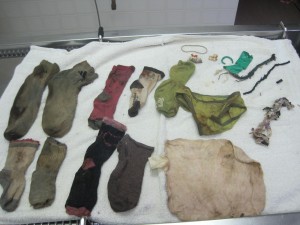
I recently fielded a call from a potential client with two neutered male dogs aged 2 and 4.
She had previously lost a middle-aged dog to an emergency bowel resection that turned septic, and had already experienced a few late-night emergency vet visits with both of her current dogs after they had ingested foreign objects.
She shared tales of their exploits with ‘stealing’ and the chaos that usually followed, involving pursuing the dogs and wresting the objects from them, or watching in dismay as they sucked socks like spaghetti noodles. One dog had consumed a half-pound of rich fudge brownies like a vacuum cleaner consumes a dust bunny, and the other routinely gobbled garbage as if he hadn’t eaten in ages.
The family was tired of being threatened by the growling from under the dining room table as the humans routinely herded them in some sort of reenactment of a prehistoric fight for the last piece of edible mammoth meat for miles, and decided that it was time for an intervention.
The Cost of Dogs Eating Foreign Objects
There are a bazillion hazards associated with dogs that eat stuff not meant for digestion, as well as owners trying desperately to get these articles back before they are destroyed or consumed.
I cannot count the calls I get from owners who have lost objects as small as diamond earrings to objects as big as cell phones, television remote controls, articles of clothing, whole baseballs, golf balls, pocket knives both open and closed, lighters, hats, you-name-it; gobbled whole by their pets in the blink of an eye with the appetites of garbage disposals.
I cannot recount the number of owners who have vigilantly observed their dogs’ bowel movements for signs of the article’s return to them and I cannot imagine the number who have waited hopelessly for the obstruction to pass unassisted.
When Dogs Swallow Foreign Objects: The Heartbreaking Outcomes
Unfortunately I DO know a number of dogs who have died from eating stuff they shouldn’t have. I also know a number of dogs who have had the life-saving intervention from skilled veterinarians who open them up and fish out the contents of their stomachs or intestines, patch them up and send them home with ‘special diets’ as they recover from their surgeries… to turn around and have to do it again, and again, and again.
I can count those dogs too.
Social media is rife with images of dogs in cones that still manage to acquire articles unfit for canine consumption.
Why Dogs Scavenge In Their Environment
There are a variety of reasons for that behavior, and a variety of resolutions for it as well. A lot of times, dogs that are denied access to explore their environments are the first to ‘investigate’ at the least opportune moments. As a result, handlers tend to get frustrated and yank on the dog’s leash, or try to prevent it by controlling leash length.
The handler shortens the leash. The dog dives harder for the object. The handler jerks the dog away. The dog learns to grab faster. Pretty soon every walk becomes an endless chorus of “OUT!”, “LEAVE IT!”, “DROP IT!”, “WHAT DO YOU HAVE NOW?”
Although those tactics may work with some dogs, if timing isn’t absolutely precise, they tend to make the problem worse, and in some cases, the behavior becomes a coping strategy (redirection) for dogs who are confused by the signals to stop, or don’t have an alternative behavior that has been reinforced with enough frequency to change the behavior.
I call it ‘grubbing’ and I have seen a lot of dogs do it in all stages of life, from different breeds and from different environments. The ones who do it the least are essentially farm dogs, or dogs who spend the vast majority of their time outside.
The goal is to make the dog choose not to do it. Part of the problem is finding something the dog prefers instead, in enough quantity for the dog to willingly forsake grubbing (which presents a high potential for self-reinforcement) for anything the handler has to offer. Not all dogs are food-motivated, although you should take the time to make them so, and not all dogs like or are interested in tug, chase or any other interactive game.
Sniffing is what dogs do. Actively investigating with their noses and ‘sampling’ with their mouths teaches dogs about their world.
Restricting access can absolutely be useful, but timing matters. If the dog is constantly receiving confusing physical signals without being shown what behavior actually works instead, grubbing can become even more persistent. For some dogs, it becomes a redirection strategy in response to frustration.
Everybody has heard the strategy of ‘make yourself more attractive’ by the positive-only zealots, and it’s not entirely wrong. At the same time, restricting access correctly is a quick way to facilitate learning.
Teaching the Dog to Leave the Environment Alone
You are outside with your puppy. He is on a leash. You have wood chips around your rhododendrons, and you know your puppy likes wood chips.
You stand in front of the wood chips at a distance of maybe 3 feet. You control your puppy’s leash length and limit to roughly two and a half feet. Just enough to frustrate him. Allow him to get frustrated. Do not move your hands, yank your leash, say a word, or make a sound. Once he realizes it’s a zero-sum game, turns to face you, or walks AWAY from the wood chips (or realistically, any distraction that captivates his interest), mark and reward.
Rinse, repeat.
Do this frequently enough, with enough things, and fairly quickly your dog begins to register the temptation as an opportunity for reward instead of a signal to be wary. The goal is not merely to prevent the dog from reaching something. The goal is to teach the dog to choose not to reach for it at all. That choice is easier to teach when the rest of the dog’s environment is managed well enough that he is not practicing inappropriate behavior all day long.
How to Stop Dogs From Eating Things They Shouldn’t
There are a lot of places I can start with this, but I’m going to start at the beginning.
- Put your stuff away, as in where the dog can’t get it. That includes making your kids be responsible for their own stuff and put it away too.
- Supervise the dog appropriately (on a leash, with you, IN THE SAME ROOM AS YOU) so you can prevent him from getting your stuff, or your kids’ stuff.
- If you cannot supervise your dog, confine him in a crate so he cannot get anything but his own stuff.
- If you are lax in your supervision and forget to confine your dog so he does manage to get your stuff, DON’T RUN AFTER HIM AND WRESTLE HIM TO GET IT BACK! To do so sets you up for any portion of the first part of this article, including the creation of resource guarding and the associated growling and biting and even faster consumption of stuff you would rather not have to fish through poo to recover, or pay exorbitant fees for surgery that could have been avoided.
Safe Toys, Appropriate Chewing and Better Choices
- Provide appropriate toys! My rule is: man-made toys (you know, the ones you pay top dollar for made of stuff that your house and its contents are made of) are considered interactive toys and are to be played with under the supervision and with the cooperation of the owner. This way the dog learns appropriate self-control as far as acquisition, possession and relinquishment of toys in a controlled and fun way; gets interaction with his owner and equally important, exercise which will mitigate both attention-seeking behavior and the boredom that leads to attention-seeking behavior.
- Toys of a more organic nature can be used as pacifier toys and can be enjoyed by the dog either in his crate or during ‘quiet times’ (under supervision, of course). Pacifier toys are pretty limited to bones. Big bones. Raw bones are best, the entire shank if possible, WITHOUT the knuckles. They do not splinter like cooked bones, are digestible and offer HOURS of fascination for most dogs. They can be used effectively for crate training and to help avert resource guarding behaviors if the dog is allowed controlled access either in his crate or while at large (under supervision, of course). Bleached shank bones are good too. You can stuff them with stuff. Stuff that you approve of, like peanut butter (out of a jar from a manufacturer that doesn’t use artificial sweeteners) or pâté de foie gras if you want. It’s up to you. Not the dog.
- Did I mention adequate exercise? They need to exercise their bodies, they need to exercise their minds. They need this routinely, as in every day, to some degree. For any dogs, young and old alike, or any derivatives thereof; a walk around the block once a day or the expectation that he will ‘self-exercise’ if his owners turn him out, unattended, in the backyard is just not going to satisfy the dog’s desire to chase, frolic, run, jump, wrestle, dig or otherwise act like a dog. Leave him to his own devices and he’ll find things to do on his own, like strip the siding off your house, or break teeth chewing the cinder blocks or bricks that comprise your foundation.
Why Chasing a Dog Makes Scavenging Worse
Not lastly, more like firstly, or anytime you forget any of the other important stuff here, never EVER run your dog down to get something back. You invite disaster. Maybe not that time, or even the next time, but I assure you: you are teaching your dog several important things. The object may have started as the prize, but once you start chasing, the game itself becomes part of the reinforcement loop:
- To defend articles with avoidance, escape or aggression
- To run from you, because you look like a giant monster trying to take your dog’s prize away
- To hide in the cubby under the bed, chair, couch, corner, closet, crate or anywhere the dog feels he can defend himself, and consume his prize
- To chew harder and swallow faster so the bigger predator (YOU) can’t get it.
Don’t set yourself up for failure by trying to wrestle away that sock, or cramming your hand forcibly down a dog’s throat after the other half of your sandwich or your kid’s iPod.
You invite disaster by thinking you will be successful. You may be once or twice, but try caling that dog to you after a few sessions like this and see what happens, or better yet, when you REALLY NEED him to drop something, and you move toward him, watch what happens. It ain’t purdy, the things people inadvertently teach their dogs…
The More Inaccessible You Make It, the More Valuable It Becomes
There is risk mitigation, and then there is making every leaf, stick, scrap and mystery odor on the ground forbidden fruit.
The more inaccessible we make something, the more desirable it can become, particularly to a dog equipped with a nose thousands of times more sensitive than ours and an evolutionary history that says finding food is never a bad investment.
As we have made survival remarkably easy for domestic dogs, we have an advantage.
We do not have to fight them for stuff.
We simply have to teach them that better options are consistently available through us.
Preventing Foreign-Object Ingestion Is Cheaper Than Surgery
They say it is far easier to ask forgiveness than to ask for permission. In the case of dogs who eat stuff, it is far easier to mitigate access and teach them to respond to some basic commands than it is to have to suffer the consequences (and often heartbreak) of having allowed them unfettered access to your stuff.
Be smart. An ounce of prevention and all that. Hiring a good trainer to help you is still way cheaper than obstruction surgery and far less heartbreaking than losing your dog because you accidentally taught him to run away instead of willingly give up the thing you don’t want him to eat.
Get Help!
If your dog has become possessive, or you want to prevent resource guarding, we offer private training and virtual coaching. Starting with a new puppy? Our puppy training program not only covers crate training, housebreaking, and early foundation skills, but also prevention strategies designed to reduce scavenging before it becomes established.. Start by scheduling a free virtual consult.