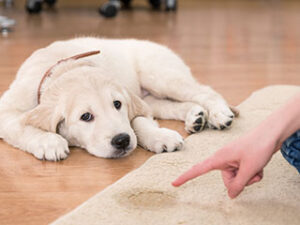
 One of the most common reasons dogs end up surrendered to shelters is a housebreaking problem. A dog who soils the house or persistently eliminates in his crate is among the top three reasons millions of dogs are given up each year. It’s a shame, because it is so easy to fix. The effort required is minimal for any owner who is willing to apply it consistently.
All it takes is timing, supervision, confinement, and a willingness to go outside in the rain. As the Northern Europeans say: “There is no such thing as bad weather, just poor clothing choices.”
A good portion of my private training practice involves housebreaking issues, both for new puppies and adult dogs with established problems. These five principles are easily applied with a minimal amount of effort and forethought.
1. When You Cannot Supervise, You Must Confine
This principle transcends all others in housebreaking dogs and puppies successfully. To understand good housebreaking technique, you must be able to recognize the signals your dog offers when he is about to relieve himself. That can only happen if he is in the same room as you, on leash, so he cannot escape your attention.
When you are not available to supervise directly, confine him to a crate sized correctly to allow comfort in the smallest amount of space possible. Confinement in your absence teaches him not only to signal when he needs to relieve himself, but to control his bowels until the opportunity is offered.
This concept is the foundation. Without it, nothing else works.
2. Control Access to Food and Water
Input equals output. If you control when your dog eats and drinks, you control when he needs to go outside. Timed, scheduled feedings reduce the incidence of finicky eating habits and allow you to predict when the dog will need to relieve himself.
If a dog is allowed to graze throughout the day, he will constantly need to go, making it nearly impossible to manage a consistent schedule. Many housebreaking problems are rooted in the owner allowing all-day access to both food and water without accounting for the predictable consequence.
3. Go Outside With the Dog
You cannot reward behavior you are not present to witness. If you send your dog out alone and assume he has relieved himself, you set him up for failure. He may have been distracted by the neighbor’s dog, the kids playing next door, or any number of things in the environment, and never got around to the actual job.
By going out with him, you are prepared to keep him on task and present to reinforce the right behavior the moment it happens. In the early stages of housebreaking, keep him on a leash during potty breaks to help him focus. This is a direct application of the first rule: you must supervise to reinforce.
4. Timing Is Everything
Housebreaking adult dogs and puppies follows the same principles. Supervise closely for signs that the dog needs to relieve himself: circling and sniffing, tail arch, rounding of the back, whining. Escort him promptly outside on leash to the designated area and reward generously when he is productive.
After, and only after, the dog eliminates outdoors, allow him limited freedom in the room you occupy, still on leash. Dogs are quick studies. They learn fast that freedom is directly connected to behavior.
There is no purpose in punishing a dog who has soiled the house after the fact. It only erodes his trust in you. Ask the honest questions first: Was he left unsupervised? Was he given adequate opportunity earlier? Was he confined when not watched? If the answer to any of those is no, the failure belongs to the management, not the dog.
5. Do Not Assume Your Dog “Knows”
The vast majority of housebreaking problems stem from the belief that dogs “know” they have done something wrong or did it out of spite. This is both inaccurate and counterproductive. Dogs do not do spite. What they know is that they had to go, and they went. The only lesson they have learned from after-the-fact punishment is that you are unpredictable and sometimes frightening for reasons they cannot understand.
Why do they leave the room after an accident? Because they can. Limit their ability to roam unsupervised, structure outings around feeding times, exercise, and waking from rest, and accompany them outside every single time, yes, including in the rain and snow, and you will get the results you are looking for.
These principles are straightforward and remarkably effective. I provide them freely here in the hope that they help owners who are struggling. There is no shortage of housebreaking advice on the internet. This is what actually works, pared down to its essentials.
Work With Us
If your dog has an established housebreaking or potty training problem, or you have a new puppy and want to get it right from the start, I work with owners through private in-home training in Carroll County and virtual training from anywhere outside our service area. Schedule a consultation and we will build a plan around what your dog actually needs.