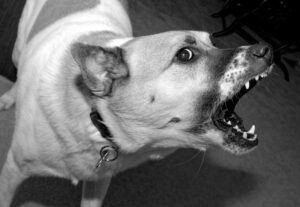
 Dog aggression is a symptom. It is not a disease. That distinction matters more than most owners realize, because the moment you treat aggression as a disease, you start overlooking causes in favor of a blanket resolution. What is required, is an understanding of what drives the behavior and a training approach that addresses it at the cause.
The vast majority of dogs that behave aggressively do so because they have been compelled to believe they are in danger. Defensive aggression is an enormous problem in domestic dogs, and one that defies quick resolution not because it cannot be mitigated, but because there are so many nuances that influence it. Having the skill to recognize triggers takes effort and time, and many owners fail to perceive their dog’s intentions before it’s too late.
Defensive vs. Offensive Aggression
Dogs are not food aggressive, dog aggressive, or human aggressive. They are either defensively aggressive, protecting self or property, or offensively aggressive, instigating and advancing. Think of it like football. The defensive teams protect the ball, the offensive teams advance the ball.This distinction matters significantly because the approach to each is fundamentally different, and conflating the two produces poor results.
It is the rare domestic dog that will offensively run toward another dog or human and arbitrarily initiate an attack. It is far more often that the dog is responding to something in its immediate environment that it perceives as a threat. The misnomer that dogs act without provocation is inherently false. There are very few dogs that act without purpose. Instinct drives mechanics, and a dog that is menacing another dog or even a human is doing so for a very specific reason. The dog may be the only one that knows what provoked him, but he has created justification in his mind for the act.
Defensive aggression is a response to fear, discomfort, or the perception of threat. It can be directed at people, other animals, or specific objects and environments. It is not random. It has a trigger, and that trigger can be identified, addressed, and significantly remediated with the correct approach.
Resource Guarding: The Most Misunderstood Form
Resource guarding is a behavior where a dog becomes defensive over something it considers valuable: food, toys, a particular person, a space, or access to any of those things. It is 100% natural. It is also 100% made worse by humans.
Resource guarding behavior can be seen in a litter of puppies almost immediately after birth as they jostle each other for the preferred spot at the milk bar. As soon as they are able to move around, they are competing for the best resources. What people don’t understand is that when a dog grabs a non-toy object and the owner responds with shouting and chasing, they are conditioning a predator to defend itself against opposition. The dog doesn’t know it isn’t in the wild. All it knows is that a larger predator is trying to take its prize away.
Throughout evolution, if a predator could successfully defend its kill, den, mate, and offspring, it assured its survival. That behavior doesn’t disappear because the dog is now living in a house and camping out on the couch.
The first thing you don’t do is make an issue over anything the dog perceives as a resource. Never approach a dog that has something it shouldn’t have. If you have made the mistake of allowing access to something it shouldn’t have, practice better management and learn from it. Remove the ability to resource guard before it becomes a pattern. Leash and collar management, direct supervision, and crate confinement when you cannot supervise, removes the opportunity entirely. Disable the dogs’ ability to self-reinforce for the acquisition and consumption of non-approved items throughout meaningful training to prevent accidents from happening.
Do Dogs Like Being Touched?
A significant portion of dog bites occur because people assume dogs enjoy physical contact on human terms. Many don’t, especially from people outside their immediate circle.
Dogs are individuals. Some are overjoyed at the prospect of physical contact and work to prolong it. Others prefer to be touched in specific ways and only for brief periods. What none of them should be is unprepared for the kind of handling life will require of them: veterinary exams, grooming, nail trims, restraint during illness or injury.
I require every dog in my care to learn to tolerate touch, even when that touch signals discomfort, whether emotional, physical, or mentally stressful. Inoculating a dog to tolerate physical restraint and manipulation prepares them for life. Many years of working with young puppies all the way to senior dogs proves this to be true.
I am not waiting for a dog to consent to physical handling. I encourage owners to start immediately on physical handling and to do something with the dog, physically, every day, until the dog accepts being touched without struggle. When you wait too long, it is a long and difficult uphill battle, and the potential for defensive aggression as a response will continue to exist as an option. It is better to address this when the dog is young, small, and easily discouraged from using its teeth.
When your dog dips his head away from your hand, he is telling you he doesn’t want you to touch him. That is not a license to move your hand closer. It is a signal to withdraw and leave the dog alone. Dogs that have never been expected to tolerate handling become a problem for groomers, veterinarians, and family members, and the owner is the reason for that.
The Role of Owner Accountability
The responsibility for aggressive dog behavior isn’t with groomers or veterinarians or any other caregiver. It rests with owners.
We don’t hesitate to take credit for a dog’s gentle nature or comedic attributes. We are reluctant to assume responsibility during its dogness. The chewing, the barking, the pulling on the leash, all get excused as puppyhood, stubbornness, or breed. When it becomes growling, snapping, and outward displays of aggression, owners are convinced it is always some attribute of the dog. “He was protecting me.” “He doesn’t like it when I do that.” None of that exempts the owner from the responsibility for what happens next.
Permissiveness leads to bad dog behavior. The pervasive assumption that a dog will outgrow a behavior leads only to more heartbreak. Dogs don’t grow out of behaviors. They grow into them. That cute jumpy, mouthy behavior in a puppy becomes a serious problem as the puppy grows in size and strength.
A quick look at my client database from pre-pandemic 2019 through 2023 showed that over 50% of dogs were presented with issues related to aggression. The mean average age was roughly two years, predominantly male, neutered, mixed-breed dogs acquired from shelters or rescues. Most had been in the home for six months or more before the owner sought help. An act of aggression directed at a family member, a guest, or in one case a police officer, compelled them to finally act.
What Training Does and Does Not Do
Training does not cause dog aggression. Poor timing and inappropriate reinforcement of incompatible behaviors certainly does.
Attempting to punish what is tantamount to fearful behavior only creates a predictor to an unpleasant event, which solves nothing and increases the likelihood of the behavior becoming more intense.
Equally, flooding the dog with food at the moment of a triggering event does not build confidence. If the dog even acknowledges the presence of the food, in the face of competing interests, it only serves to confirm that the trigger is an event worth losing composure over. Neither approach addresses the root cause.
Dog training cannot cure aggression, primarily because aggression is a tactic. Training is designed to control behavior, and that includes aggression. A trainer may be able to install new responses that render a dog safe for an experienced handler, but if that handler fails to maintain the training, the dog is not exempt from reverting to the behavior in the future.
Obedience foundation does not suppress aggression. What it does is give the dog a framework for decision-making under stress. A dog with a reliable obedience foundation has more options available when it encounters a trigger. It is not a cure, but it is the necessary underpinning of any serious behavior modification program. One cannot be cleaved from the other.
What Owners Get Wrong
Most owners of aggressive dogs fall into one of two categories: those who excuse the behavior and those who escalate it. Both outcomes make the problem worse.
Know your dog’s triggers. Know the distance at which the dog begins to react, and do not put the dog in situations it is not yet equipped to handle. Management is not a substitute for training, but it is a necessary part of the process while training is underway. A dog that is still rehearsing aggressive behavior freely is not a dog in a training program. It is a dog waiting for the next incident.
The vast majority of aggressive acts can be remediated simply by knowing what causes them and by installing alternatives for behavior in the dog. Training does that.
Work With Us
Aggression is not a death sentence. It is a behavior problem, and behavior problems have solutions. I work with aggressive dogs regularly, including cases that other trainers have declined. Through private in-home training in Carroll County and virtual training from anywhere in the world, I can help you understand what is driving your dog’s behavior and build a plan to address it. Schedule a consultation and we will start there. If you cannot work with me in person, virtual dog training is available from anywhere in the world and works for the majority of aggression cases.